
Measles Is Back in Texas. Here’s What Every Parent Needs to Know.
Most parents raising children in Texas today have never seen a measles case in person. For a generation, the MMR vaccine kept this disease so thoroughly at bay that it became something people read about in history books. That changed in 2025, and the situation in 2026 is giving public health officials serious cause for concern.
Here’s what’s happening, what to watch for in your child, and when it’s time to seek emergency care.
What Happened in Texas and Why It Matters Now
In January 2025, a single measles case was confirmed in Gaines County in West Texas. What followed was the largest measles outbreak the United States had seen since the disease was declared eliminated in 2000. By the time Texas health officials declared the outbreak over in August, 762 people had been infected, 99 were hospitalized, and two school-age children had died. Close to three-quarters of all cases were in children.
The outbreak was fueled by low vaccination rates in the affected communities. In Gaines County, only 77% of kindergartners had received measles vaccinations, which is far short of the 95% coverage needed to protect a community from spread. Measles doesn’t need much of an opening. It is one of the most contagious viruses known to science: nine out of ten unvaccinated people exposed to it will become infected. The virus can linger in the air or on surfaces for up to two hours after an infected person has left a room.
Texas declared that outbreak over, but measles hasn’t gone away. New cases have already been confirmed in Rockwall County and in the Hill Country (Bandera and Kendall counties) in early 2026, both linked to travel and contact with ongoing outbreaks in other states. Nationally, nearly 1,000 measles cases were confirmed in the U.S. in just the first two months of 2026 — more than four times the case count at this same point last year. Texas parents cannot afford to treat this as yesterday’s problem.
Know the Symptoms
Measles doesn’t start with a rash. That’s one of the reasons it spreads so effectively. By the time the telltale spots appear, a child has often already been contagious for days.
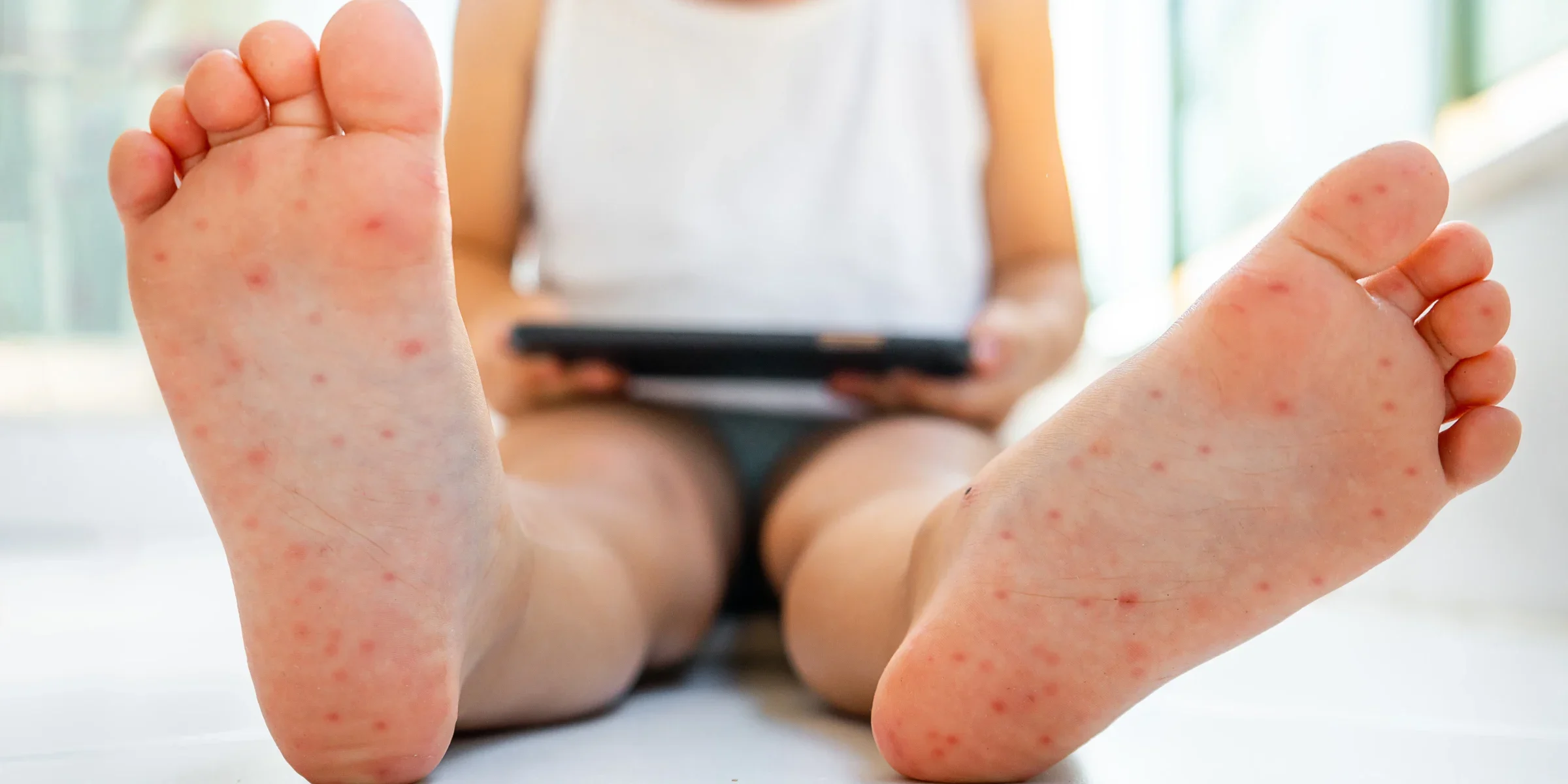
The illness typically begins with a high fever, persistent cough, runny nose, and red, watery eyes. These early symptoms can easily be mistaken for a bad cold or the flu, and they last two to four days before the rash appears. The rash itself starts as flat red spots on the face and hairline, then spreads downward to the neck, trunk, and limbs over the course of a few days.
A child is contagious from four days before the rash begins through four days after it appears. If your child has been around anyone with measles or has traveled recently to an area with an active outbreak and develops any of these symptoms, contact your care team before heading anywhere in public.
When to Seek Emergency Care
Measles can range from miserable to life-threatening, particularly in young children. During the 2025 Texas outbreak, one in five infected children required hospital care. Complications can escalate quickly, and some of the most serious ones develop without much warning.
Seek emergency care right away if your child is experiencing any of the following:
- Fever above 101°F that doesn’t respond to medication
- Difficulty breathing or rapid, labored breathing: this can signal measles-related pneumonia, the most common cause of measles death in young children
- Signs of dehydration: no tears when crying, dry mouth, sunken eyes, or significantly reduced urination
- Extreme lethargy or difficulty staying awake
- Seizures
- Confusion or unusual behavior: in rare cases, measles can cause encephalitis, a dangerous swelling of the brain that can develop during or after infection
If measles is a concern, call ahead before arriving so the team can take appropriate precautions. Given how contagious this virus is, a brief heads-up protects other families in the waiting area.
How Measles Is Treated
This is something many parents don’t realize going in: there is no antiviral medication approved to treat measles. Medical care is supportive, focused on helping the body manage the infection and preventing complications from taking hold.
In practice, that means keeping fever under control, maintaining hydration, and monitoring closely for secondary infections like pneumonia or ear infections that may require antibiotic treatment. Children who are hospitalized, very young, or showing signs of complications may also receive high-dose vitamin A supplementation under medical supervision. This treatment has been shown to meaningfully reduce the severity of measles and lower the risk of serious complications, particularly in children under two.
What this means for families: the emphasis is on early recognition, close monitoring, and acting quickly when symptoms escalate. There is no medication to shorten the illness or stop it once it starts. The best treatment, by far, is prevention.
A Long Shadow: What Parents Should Know About SSPE
Most parents are aware that measles can be dangerous in the short term. Fewer know about a rare but devastating complication that can surface years later.
Subacute sclerosing panencephalitis, or SSPE, is a progressive and fatal brain condition caused by the measles virus lying dormant in brain cells long after the initial infection resolves. There is no cure. Symptoms typically emerge six to eight years after the original measles infection, often beginning subtly — declining school performance, personality changes, unusual clumsiness — before progressing to seizures, loss of motor control, dementia, and ultimately death. The risk is highest for infants infected before their first birthday, affecting approximately one in 600 in that age group.
SSPE cannot occur from the measles vaccine — only from wild measles infection. It is a sobering reminder that the consequences of a measles infection are not always resolved when the rash fades.
The Protection Picture: What Parents Should Know About the MMR Vaccine
Two doses of the MMR (measles, mumps, and rubella) vaccine prevent more than 97% of measles infections. The standard schedule calls for the first dose between 12 and 15 months and the second between 4 and 6 years of age.
If your child is under 12 months and you live in or plan to travel to an area with known measles activity, the CDC recommends an early dose as young as 6 months, with the standard schedule continuing afterward. If your child is older and has received only one dose, a second dose can be given as soon as 28 days after the first.
If you’re unsure of your child’s vaccination status, now is the time to check. A call to your pediatrician or a visit to your county health department can get records verified and any missing doses administered quickly.
One important note: a small number of vaccinated children can still contract measles, but their illness is almost always milder and they are far less likely to spread it to others. Vaccination protects not only your child but the children around them who are too young to be vaccinated yet.
The Bigger Picture
Measles case counts in the U.S. reached a 34-year high in 2025, and 2026 is tracking to be worse. Childhood vaccination coverage has been declining nationally for several years, dropping from 95.2% in the 2019-2020 school year to 92.5% in 2023-2024 — a seemingly small shift that has enormous consequences for community protection. Public health experts warn the U.S. is at risk of losing its measles elimination status, a designation it has held since 2000, if current trends continue.
Texas has been at the center of this story. It doesn’t have to stay there.
The good news is that prevention is straightforward. Vaccination works, it’s safe, and it’s widely available. If there are questions or concerns about the MMR vaccine, a conversation with a trusted healthcare provider is the right place to start — not a reason to delay.
If You’re Concerned, Come In
If your child is showing symptoms that worry you, or if you’re not sure whether what you’re seeing is measles, don’t wait. At Surepoint Emergency Centers across Texas, children are seen quickly by emergency-trained physicians who can evaluate symptoms, order necessary testing, and get you answers in a single visit. If measles is a concern, let the team know when you arrive so appropriate precautions can be taken right away.
Measles Research:
https://www.cdc.gov/measles/data-research/index.html
https://thehill.com/homenews/5736370-map-which-states-have-the-most-measles-cases-in-2026/
https://pmc.ncbi.nlm.nih.gov/articles/PMC12619093/
https://www.aha.org/news/headline/2025-08-18-texas-declares-its-measles-outbreak-over
https://en.wikipedia.org/wiki/Subacute_sclerosing_panencephalitis
https://medlineplus.gov/ency/article/001419.htm
https://www.cdc.gov/mmwr/preview/mmwrhtml/00001185.htm
https://www.rockwallcountytexas.com/m/newsflash/home/detail/1057
https://pmc.ncbi.nlm.nih.gov/articles/PMC10317549/
https://www.cdc.gov/measles/media/pdfs/2025/05/hcp-caring-for-patients-measles-fact-sheet.pdf