

Medically reviewed by Dr. Rama Narla, MD, American Board of Family Medicine, Surepoint Emergency Centers
Last reviewed: October 2026
Every October, the same urban legend-driven concerns make the rounds: strangers hiding needles in apples, neighbors poisoning candy, trick-or-treat bags that need to be screened like airport luggage. Parents across Texas sort pillowcases under the kitchen light on Halloween night, and that instinct comes from a good place.
The research points somewhere less cinematic. After all, most Halloween injuries that reach the emergency department are mishaps involving pumpkins, costumes, and decorating. The candy check still matters, but for different reasons than the scary stories suggest. Halloween falls on a Saturday this year, which usually means more parties and more people out after dark, so it is a good year to put attention where it does the most good.

Pumpkin Carving Is the Top Cause of Halloween Injuries
The U.S. Consumer Product Safety Commission has estimated that U.S. emergency departments treat an average of about 3,200 Halloween-related injuries annually. Pumpkin carving accounted for 55 percent of emergency room visits between 2020 and 2023. Falls from decorating, tripping on costumes, or walking while trick-or-treating accounted for another 25 percent. More than half of the people injured were adults.
A national study in the American Journal of Emergency Medicine estimated more than 20,500 pumpkin-related knife injuries treated in emergency departments from 2012 through 2021. Nearly 88 percent were to the hand, most often the thumb and index finger. Injuries clustered in October and peaked on October 30.
The pattern makes sense once you picture it. A pumpkin rind is tough, so people push hard with a kitchen knife. The blade slips and lands in the hand holding the pumpkin steady. A cut to the palm side of a finger can look small and still reach a tendon or nerve, which is why some of these injuries need more than a bandage.
Let younger children draw the design and scoop the inside while an adult does the cutting. Carving kits with small serrated saws are less likely to slip than a sharp kitchen knife. Keep hands, tools, and the work surface dry, carve in a well-lit space, and cut away from your body in small, controlled strokes.
The Most Dangerous Hours Are After Dark
Injuries are most common in the kitchen, but the most serious ones happen on the street. A study in JAMA Pediatrics examined U.S. traffic fatality data from 1975 through 2016 and found the risk of a pedestrian death was 43 percent higher on Halloween evening than on comparison nights a week before and after. That worked out to about four additional pedestrian deaths each Halloween. For children ages 4 to 8, the risk was roughly 10 times higher. The danger was concentrated in the early evening, when trick-or-treating is busiest and daylight is gone.
Dark costumes, excited kids darting between parked cars, and drivers who are distracted or impaired all play a part. Reflective tape on costumes and bags, a flashlight or glow stick for every child, and an adult with any child younger than 12 go a long way. Cross at corners, not between cars. If you are driving that night, slow down in neighborhoods, put the phone away, and take extra care backing out of driveways.
Costumes Have Their Own Risks
Costumes that drag on the ground, oversized shoes, and masks that block peripheral vision all contribute to falls. Face paint is often a better choice than a mask. Test it on a small patch of skin a day or two ahead, especially for children with sensitive skin or eczema.
Decorative contact lenses deserve a special mention. The FDA classifies all contact lenses, including cosmetic ones that do not correct vision, as medical devices that require a prescription. Selling them without one is illegal, yet they still turn up at costume shops, beauty supply stores, and online. Poorly fitted lenses can scratch the cornea and lead to infections and corneal ulcers, which can progress quickly and threaten vision. If you want the look, get lenses prescribed and fitted by an eye care professional.
Glow sticks are generally low risk, but children chew on them. The liquid inside, usually dibutyl phthalate, is a mild irritant. A taste in the mouth usually causes brief irritation. A splash in the eye is more uncomfortable and should be rinsed right away with room-temperature water for at least 10 to 15 minutes. Battery-operated lights are also a safer choice than candles inside jack-o-lanterns, especially along walkways where costumes brush past.

The Candy Bag: What Is Actually Worth Checking
The fear of strangers deliberately poisoning candy has very little evidence behind it. Sociologist Joel Best of the University of Delaware has spent decades tracking these reports. After following up on roughly 100 newspaper accounts dating back to 1958 with police and hospitals, he could not confirm a single case of a child killed or seriously harmed by candy a stranger tampered with. The best-known case happened in the Houston area in 1974, when a boy died after eating cyanide-laced candy. The poisoner was his own father, not a neighbor.
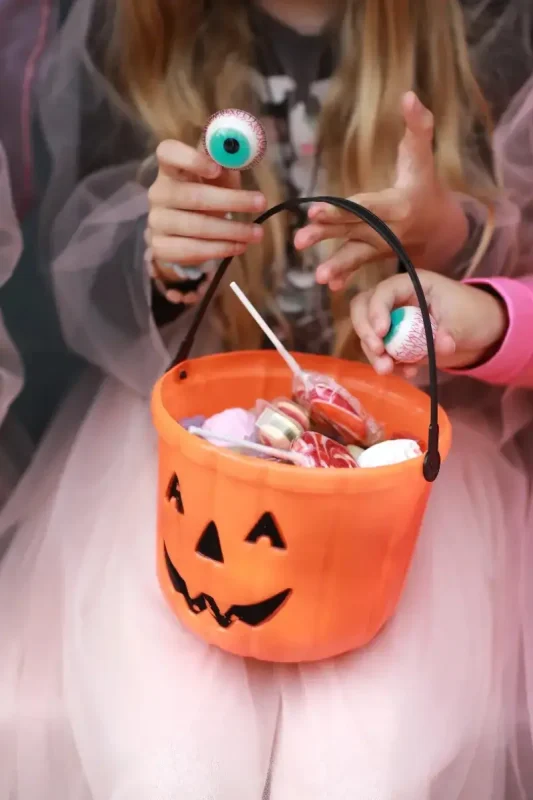
So, the candy check is still worth doing, just aimed at the right things. Hard candy, gum, nuts, popcorn, and small toys are choking hazards for toddlers. Children with food allergies need every label checked, since fun-size treats can carry different ingredients than the full-size version. Homemade treats are worth skipping simply because you cannot know what is in them.
While this is not a story about strangers handing out drugs at the door, there is another item to watch for: THC edibles that look like ordinary candy or snacks. Certain hemp-derived THC products can legally be sold in Texas to adults 21 and older, making them something children may encounter even outside Halloween. Federal regulators have taken action against companies using packaging that mimics familiar brands such as Nerds, Doritos, and Cheetos, but the potential for confusion remains. The concern here is accidental exposure: a child picking up an edible at a party, finding one left on a counter, or mistaking a package in a bag for a familiar treat.
Young children are the most likely to be affected. A study published in BMC Public Health in August 2026 found the rate of unintentional recreational drug ingestions among U.S. children younger than 6 rose more than 3,300 percent from 2000 to 2024, driven mostly by cannabis edibles. Most children had mild effects, but about 1 in 20 had serious ones.
When the candy comes home, set aside anything with unfamiliar branding, a cannabis or THC label, or a name that plays on a familiar candy. If anyone in the household or a visiting guest uses edibles, keep them in their original child-resistant packaging and far out of reach of minors, the same advice we gave for melatonin gummies in The Trouble with Bedtime Gummies and other Sleepmaxxing Emergencies. In young children, THC can cause unusual sleepiness, unsteady walking, vomiting, and a fast heart rate, and symptoms can take 30 minutes to a few hours to appear.
Signs This Isn’t Something to Wait Out
- A cut that will not stop bleeding after 10 minutes of firm, direct pressure, a wound that gapes open, numbness past the cut, or a finger that will not fully bend or straighten: get emergency care. These can signal tendon or nerve damage.
- A child hit by a car, even at low speed and even if they seem fine: call 911 or get them evaluated right away. Some internal injuries do not show symptoms at first.
- A fall followed by repeated vomiting, a worsening headache, confusion, unusual sleepiness, or any loss of consciousness: get emergency care for a possible head injury.
- Eye pain, redness, light sensitivity, blurry vision, or discharge after wearing costume contacts, or eye pain that continues after rinsing out glow stick liquid: remove any lenses and get seen the same day. A corneal ulcer can worsen within hours.
- A child who may have eaten a THC edible: call the Texas Poison Center Network at 1-800-222-1222 right away, even before symptoms appear, and share whatever you know about the product. Call 911 if the child is hard to wake, has trouble breathing, or has a seizure.
- Hives with swelling of the lips, face, or tongue, wheezing, or vomiting after a treat: use an epinephrine auto-injector if one is prescribed and call 911. These can be signs of a serious allergic reaction.
- Something swallowed, splashed, or chewed that you are unsure about: call the Texas Poison Center Network at 1-800-222-1222. It is free, confidential, and available around the clock.
A Simpler Plan for Halloween Night
- Let kids design and scoop the pumpkin while an adult handles the cutting.
- Add reflective tape and a light to every costume, and keep an adult with children younger than 12.
- Choose costumes that fit, choose face paint over masks, and use prescription-only contact lenses.
- Sort candy for choking hazards, allergens, and unfamiliar or look-alike packaging.
- Store edibles and medications in their original packaging, apart from the candy. Our guide, Clear Out the Cabinet Before Take Back Day on October 24, covers what to do with anything you no longer need.
At Surepoint Emergency Centers, the team can run labs and imaging in the same visit, 24 hours a day. There is no need to wait for a primary care appointment or wonder whether this is “bad enough” for the ER.
Dr. Rama Narla, MD, is a board-certified family medicine physician and Medical Director at Surepoint Emergency Center in Denton, TX. She has 27 years of experience in emergency medicine across Texas.
If you are experiencing a medical emergency, call 911 or visit your nearest emergency room immediately. This article is for informational purposes only and does not replace guidance from your healthcare provider.
Sources include: U.S. Consumer Product Safety Commission, Halloween Safety data (2022); American Journal of Emergency Medicine, Pumpkin Carving Knife Injuries: National Incidence and Trends of Hand Injury (2022); Staples JA, et al., Pedestrian Fatalities Associated With Halloween in the United States, JAMA Pediatrics (2018); U.S. Food and Drug Administration, Colored and Decorative Contact Lenses: A Prescription Is a Must; Poison Control (poison.org), Glow Sticks; Joel Best, University of Delaware, research on Halloween candy tampering; U.S. Food and Drug Administration and Federal Trade Commission, Warnings on Copycat Food Products Containing Delta-8 THC (2023); Texas Department of State Health Services, Consumable Hemp Program; BMC Public Health, Unintentional Recreational Drug Ingestions Among Children Younger Than 6 Years, 2000-2024 (2026), and Nationwide Children’s Hospital news release; Texas Poison Center Network, poisoncontrol.org. Current as of October 2026.