
Dr. Ami Thakkar, a physician at Surepoint Emergency Centers, was almost not born.
His father grew up in a small village in India with no medical services. When his mother went into labor, there was no hospital to drive to, no ambulance to call. She labored for three days before his grandfather placed her on a wooden cart pulled by brahma bulls and traveled to the nearest city so she could deliver safely.
That story shaped Dr. Thakkar’s entire career. His father eventually earned a scholarship to Tuskegee University in Alabama, and the family built a life in the United States. Dr. Thakkar became one of the first physicians from that village, driven by the understanding that access to care is not something everyone can take for granted.
It is a dramatic example. But the principle behind it is not as far removed from everyday life in Texas as it might seem.

Distance Still Changes Outcomes
Research consistently shows that the time between a medical emergency and the start of treatment is one of the strongest predictors of how things turn out. A study published in JAMA Surgery found that the median EMS response time in the United States is about 7 minutes in urban areas but climbs to more than 14 minutes in rural settings. In some cases, nearly 1 in 10 rural patients waits close to 30 minutes before EMS arrives. Longer response and transport times have been associated with worse outcomes in trauma, cardiac events, and stroke.
Texas is a big state. Even in metro areas like Dallas-Fort Worth, Houston, and San Antonio, the distance between where you are and where you can be evaluated can vary significantly depending on the time of day, traffic conditions, and which facilities are nearby. For families in suburban and exurban communities, the nearest hospital emergency department may not be the closest option for emergency-level care.
What Freestanding ERs Were Built to Solve
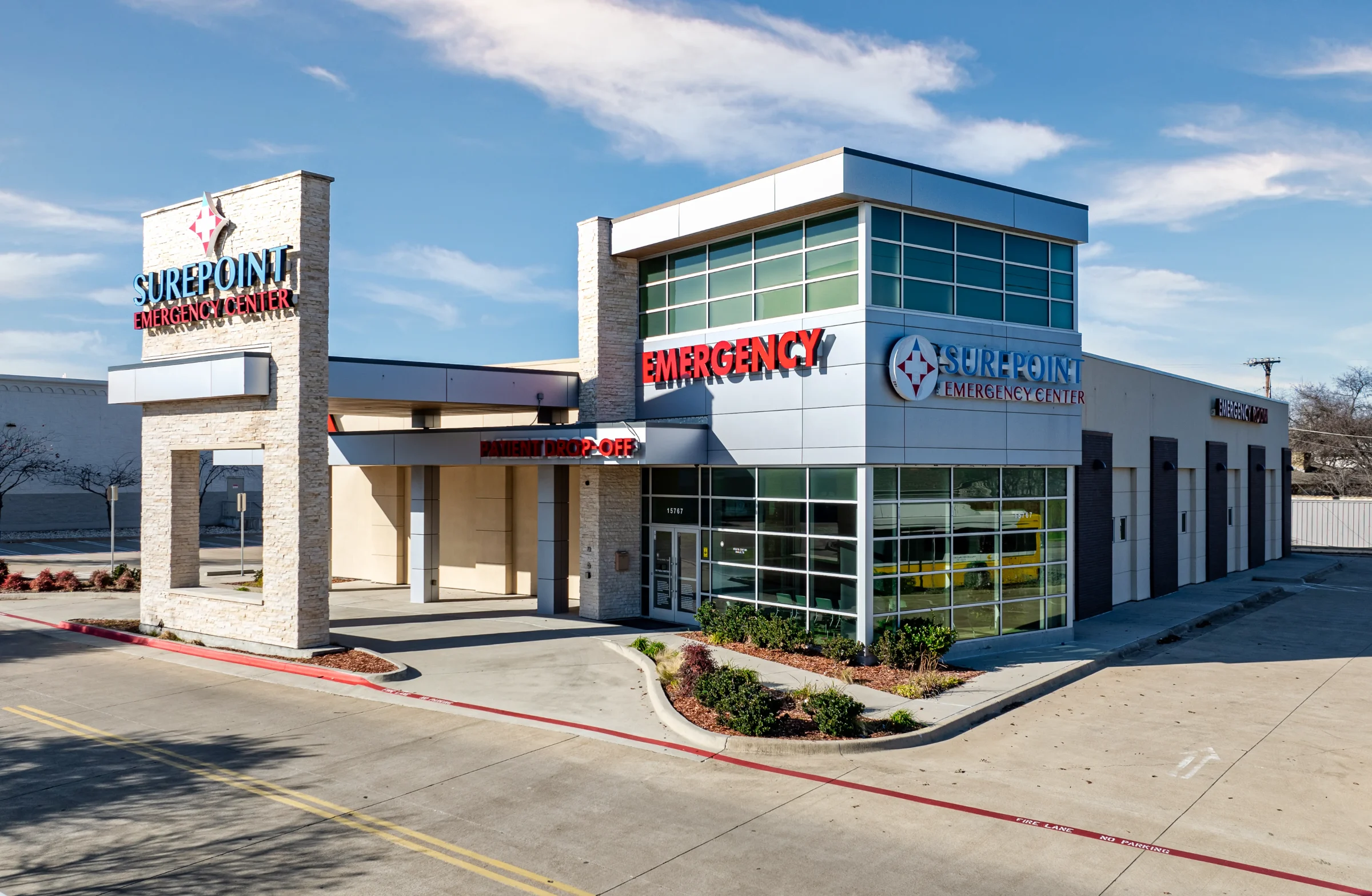
Freestanding emergency rooms exist to close that gap. They are full emergency departments with emergency-trained physicians, on-site imaging, and lab work, just not physically attached to a hospital. The clinical capability is the same: the team can evaluate, diagnose, treat, stabilize, and monitor patients around the clock. If a patient needs surgery or inpatient admission, the ER coordinates a direct transfer.
The difference is location. Freestanding ERs can be placed closer to the communities they serve, in neighborhoods where a hospital may be 20 or 30 minutes away. That matters at 2 a.m. when a child spikes a dangerously high fever. It matters when chest pain starts during rush hour. It matters when a fall results in a head injury and the family needs answers quickly.

The People on the Other Side of the Door
Dr. Thakkar is one of many Surepoint physicians whose path to medicine was shaped by something personal. Dr. Steven Thompson decided to become a doctor after watching a physician make house calls to his mother when she was too sick to travel. Dr. Christian Moya knew he wanted to practice medicine from the time he was five years old. Dr. Chantel McNair chose the field because she wanted to help people at their most vulnerable and bring some comfort in those moments.
What they share is a belief that emergency care should be accessible, that patients deserve time and attention, and that the team providing care should be part of the community it serves.
At Surepoint Emergency Centers across Texas, that is the standard every shift, every day. If your family needs emergency care, the team is there, close by and ready. No appointment, and little to no wait.
If you are experiencing a medical emergency, call 911 or visit your nearest emergency room immediately. This post is for informational purposes only and does not replace guidance from your healthcare provider. EMS response time data referenced from JAMA Surgery (2017) and the National Rural Health Association. Current as of April 2026.