
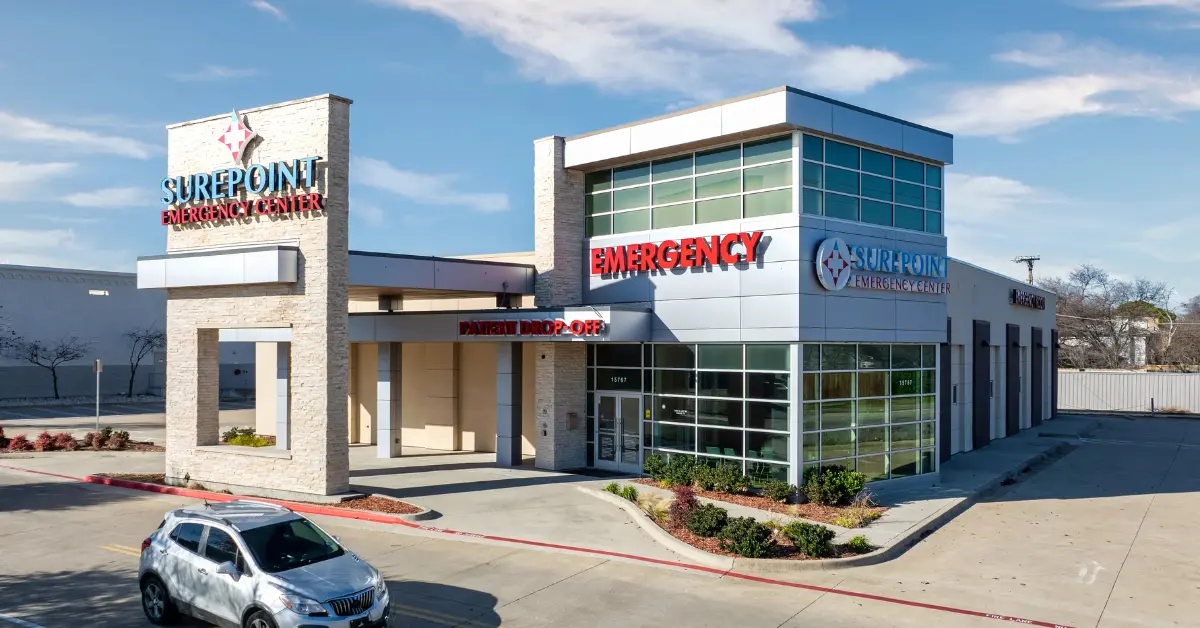
Texas hospitals are under pressure that does not show up in any single headline. A 2025 report from the Center for Healthcare Quality and Payment Reform identified 76 Texas hospitals at high risk of closure, the most of any state in the country. The pressures driving those numbers are structural and longstanding. Reimbursement rates, from both private insurers and government payers, have not kept pace with the cost of operating an emergency department. Federal Medicaid reductions passed by Congress in the summer of 2025 added new pressure to an already strained model.
The headlines on hospital strain tend to focus on rural Texas, and for good reason. But the same pressures show up in a different shape across Dallas-Fort Worth, where population has outpaced hospital capacity for two decades, and where the urban hospitals absorbing displaced demand are already operating at the top of national volume rankings.
Parkland Memorial Hospital in Dallas recorded 235,893 emergency department visits in 2024, the highest of any hospital in the country, according to Becker’s Hospital Review. John Peter Smith Hospital and Texas Health Harris Methodist, both in Fort Worth, also appear on the national list of busiest emergency departments.
What those rankings describe, from the inside of a car on a Tuesday evening, is a system in which the closest hospital is often the busiest one, and the next-closest is a longer drive than the map suggests. Centers for Medicare and Medicaid Services data covering the 12-month period ending June 2025 puts the national median time spent in the emergency department at 161 minutes, and high-volume Texas hospitals routinely exceed that. Somewhere inside that compression, between long drives and longer waits, freestanding emergency rooms freestanding emergency rooms have grown into a meaningful piece of how Texas delivers emergency care, with most patients typically seen by a physician within minutes of arrival rather than hours.
The Spectrum of Care
Texas healthcare, like healthcare anywhere, works on a continuum. Primary care physicians manage long-term health, chronic conditions, and the relationships that span decades. Urgent care centers cover the in-between space of sore throats, sprained ankles, and minor infections. Hospital emergency departments anchor the most complex end of the spectrum, with operating rooms, intensive care units, and specialty teams under one roof.
Freestanding emergency rooms occupy a specific position within that continuum. The American College of Emergency Physicians describes them as facilities staffed by emergency physicians and equipped with laboratory and radiology equipment, including CT scanners, ultrasound, and x-ray machines, typically open 24 hours a day, seven days a week. They are built to handle the same range of true emergencies a hospital ER sees, from chest pain to severe allergic reactions to fractures requiring imaging and reduction. They are not a substitute for primary care, and they are not in competition with urgent care.
In Texas, these facilities operate under Chapter 509 of the Texas Administrative Code, which sets standards for staffing, equipment, patient screening, transfer agreements, and inspections. The framework dates to 2009 legislation that created the licensing pathway for independent freestanding emergency centers in the state.
Why the Model Took Hold in Texas
Texas has scale problems other states do not. A 20-minute drive to the nearest hospital becomes 50 minutes in evening traffic on Loop 820 or 635. Suburban communities that doubled in population over a decade did not see their hospital capacity double alongside them. Rural communities have watched their hospitals close outright. In both cases, the result is the same: longer drives, longer waits, and a system under measurable strain.
Freestanding emergency rooms did not appear in this landscape by accident. They emerged because there was a defined gap between what urgent care could safely handle and what required a hospital, and that gap was widening in the exact geographies where hospital capacity was contracting.
What Neighborhood Should Mean
The word neighborhood is overused in healthcare branding, and it deserves a more honest definition. A genuine neighborhood emergency room is one that the community recognizes as part of its civic infrastructure rather than as a passing commercial presence. The same families come back across the years. Local pediatricians know which facility to call after hours. High school athletic trainers know which team will see their athletes after a Friday night game. Sponsorships of community events are not marketing exercises but reflections of where the staff’s own children go to school.
That standard is harder to meet than it sounds, and it is the standard worth applying when evaluating any facility that calls itself local.
The Position Within a Larger System
Freestanding emergency rooms are most useful when they are understood as complementary infrastructure, not replacement infrastructure. Hospital emergency departments remain essential for the cases that require admission, surgical intervention, or specialty teams. ACEP guidance specifies that freestanding emergency departments must maintain policy agreements and procedures for effective and efficient transfer to higher levels of care, including cardiac catheterization labs, surgical suites, and intensive care units. The transfer pathway is a feature of the design, not a workaround for its limitations.
For the substantial share of patients whose emergencies can be fully evaluated and treated on-site, the freestanding model offers faster access to physician-level care with full diagnostic capability. For the patients who do require hospital admission, it offers a faster, cleaner path into the right hospital bed than a self-directed trip to a crowded urban ER often does.
Where Surepoint Fits
Surepoint Emergency Centers were designed around this complementary role. Each location offers on-site CT, ultrasound, x-ray, and full laboratory capability, staffed by emergency-trained physicians around the clock, including nights, weekends, and holidays. When a hospital transfer is the right next step, that coordination is built into the workflow. When it is not, families leave with answers and a clear plan, often the same evening they arrived.
In a state where the gap between need and access continues to be the defining feature of the healthcare landscape, that is the role a neighborhood emergency room is meant to play, and it is the one Surepoint shows up for across Texas every day.
If you are experiencing a medical emergency, call 911 or visit your nearest emergency room immediately. This post is for informational purposes only and does not replace guidance from your healthcare provider.
Sources: Center for Healthcare Quality and Payment Reform reporting via Texas Public Radio (https://www.tpr.org/podcast/the-source/2025-10-20/with-pending-cuts-texas-rural-hospitals-struggle-to-stay-open), Texas Tribune on rural health funding (https://www.texastribune.org/2025/12/29/texas-rural-health-care-281-million-federal-program/), Becker’s Hospital Review on hospitals with the most ED visits in 2024 (https://www.beckershospitalreview.com/rankings-and-ratings/hospitals-with-the-most-ed-visits-in-2024/), KERA News on Parkland bed expansion (https://www.keranews.org/health-wellness/2026-04-21/parkland-memorial-hospital-expansion-beds-growing-demand-emergency-medicine-2026-fifa-world-cup), Centers for Medicare and Medicaid Services Timely and Effective Care data via Becker’s Hospital Review (https://www.beckershospitalreview.com/rankings-and-ratings/ed-visit-times-by-state/), American College of Emergency Physicians on freestanding emergency departments (https://www.acep.org/patient-care/policy-statements/freestanding-emergency-departments and http://newsroom.acep.org/2015-01-09-freestanding-emergency-departments), and Texas Administrative Code Chapter 509 via Texas Health and Human Services Commission (https://regulations.justia.com/states/texas/title-26/part-1/chapter-509/). Current as of June 2026.